Good Playlists vs. Bad Playlists: How to Tell If a Placement Is Actually Worth It
Nine red flags, an eight-step vetting checklist, and the real risks of a bad placement: penalty fees, delisting, and lasting algorithmic damage.
Playlists are still one of the most powerful discovery engines in music. They are also the single easiest place for an indie artist to waste money.
There is an entire cottage industry of “curators” who inflate their playlist stats with bot streams and low-quality traffic, then charge independent artists for a placement. The pitch is seductive: a few hundred dollars, a few weeks, and suddenly you have 10,000 monthly listeners. The problem is that those listeners aren’t people. They’re a number on a dashboard that will not buy a ticket, join your mailing list, or show up for your next release.
This guide covers what separates a genuinely valuable playlist from a vanity one, why playlists are still worth pursuing, and the exact checks to run before you say yes to a placement.
Key takeaways
- A good playlist has a point of view. Tight length, coherent sound, a real human curator, and an audience that actually listens through.
- A bad playlist is a numbers farm. Hundreds of songs, 5+ hours long, no genre logic, and follower counts propped up by fake or incentivized streams.
- Monthly listeners are a vanity metric. Followers, saves, and repeat listeners are the numbers that predict a career.
- Paying for guaranteed placement violates Spotify’s terms. Since April 2024, Spotify charges labels and distributors a per-track fee when flagrant artificial streaming is detected, and your distributor passes that cost to you.
- Less is more. One placement on a respected, well-loved playlist beats a hundred placements on lists nobody listens to.
The three kinds of Spotify playlists
Not all playlists work the same way, and knowing which type you’re dealing with changes how you should value it.
Editorial playlists are programmed by Spotify’s in-house music teams — things like RapCaviar, New Music Friday, and Fresh Finds. You cannot buy your way onto these. The only legitimate route is pitching through Spotify for Artists at least 7 days before release (most guidance suggests 3–4 weeks). Anyone who offers to sell you an editorial placement is lying.
Algorithmic playlists are generated per-listener: Discover Weekly, Release Radar, Daily Mix, and Autoplay. Nobody curates these. They respond to behavioral signals — save rate, completion rate, skip rate, repeat listens, and whether real users add your track to their own playlists. These are usually the biggest long-term driver of streams for an independent artist, and they’re the reason fake streams are so damaging: garbage input teaches the system to show your music to the wrong people, or to nobody.
User and third-party curator playlists are made by everyone else — labels, blogs, brands, DJs, tastemakers, and ordinary fans. This is where the real opportunity lives and where virtually all of the fraud lives. A brilliant independent curator with 4,000 engaged followers can genuinely change your trajectory. A “curator” with 400,000 fake followers cannot.
What a good placement actually gets you
A real placement is valuable for reasons that have very little to do with the stream count itself:
- New followers, which means the next release lands in their Release Radar automatically
- Saves and library adds, the strongest signal you have that someone intends to hear the song again
- Algorithmic lift, because genuine engagement teaches Spotify who your music belongs next to
- Contextual credibility — being on a list people respect signals something to A&Rs, bookers, sync supervisors, and other curators
- Data you can act on, like which cities to route a tour through
Notice that “monthly listeners” is not on that list.
What are the signs of a bad playlist?
Here are the specific things to look for before you pay anyone anything.
1. Saturated stats: too many songs, too many hours
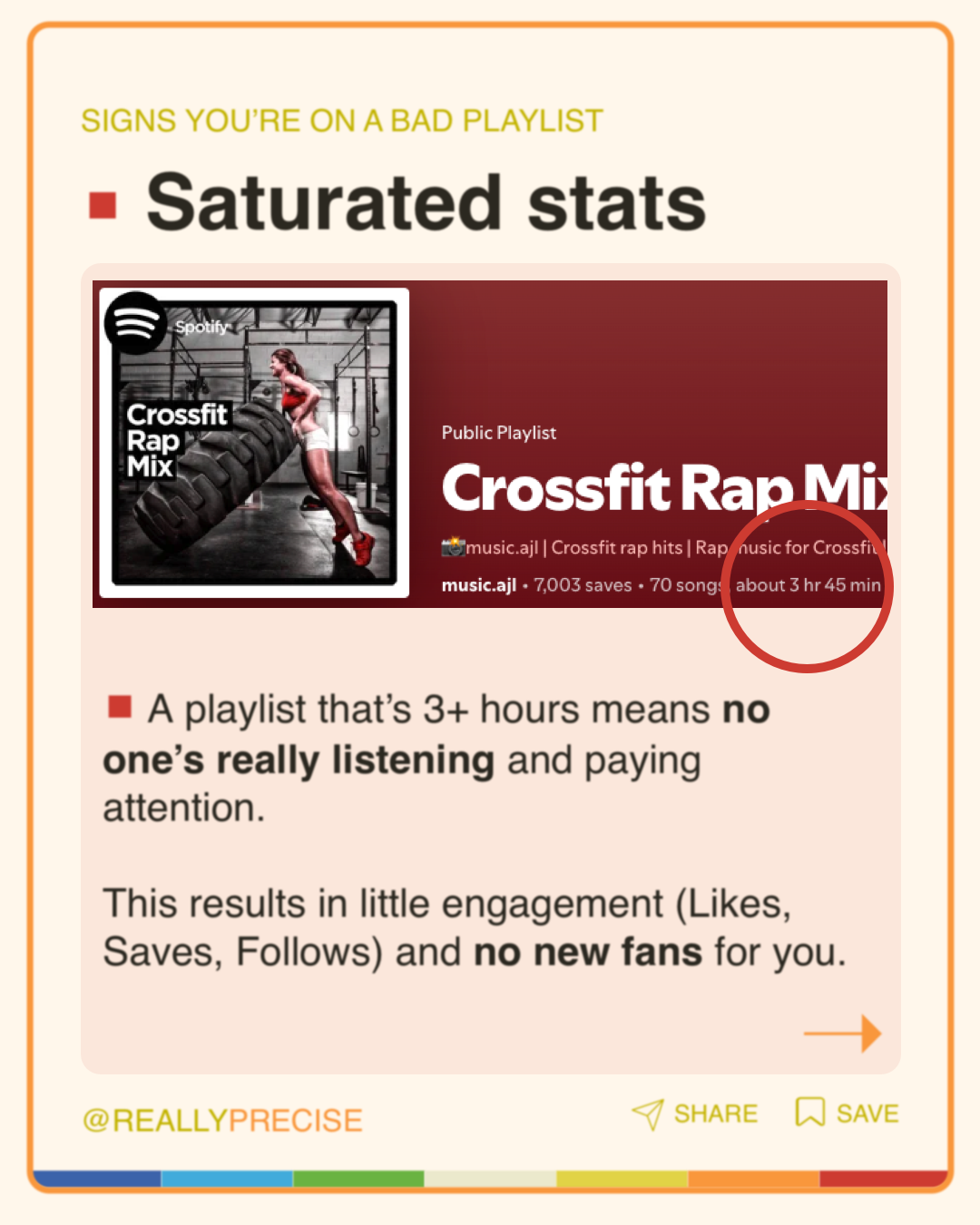
A playlist over roughly three hours long is a red flag. If a list has 70, 150, or 400 songs, no human is listening to it front-to-back, which means your track is buried somewhere nobody will reach. Long playlists exist to fit as many paying artists as possible, not to serve listeners.
Healthy curated playlists tend to run 30–60 tracks, or about 90 minutes to two hours — short enough that a real person can actually get through it, and short enough that the curator has to make real choices about what belongs.
2. Fake Spotify branding
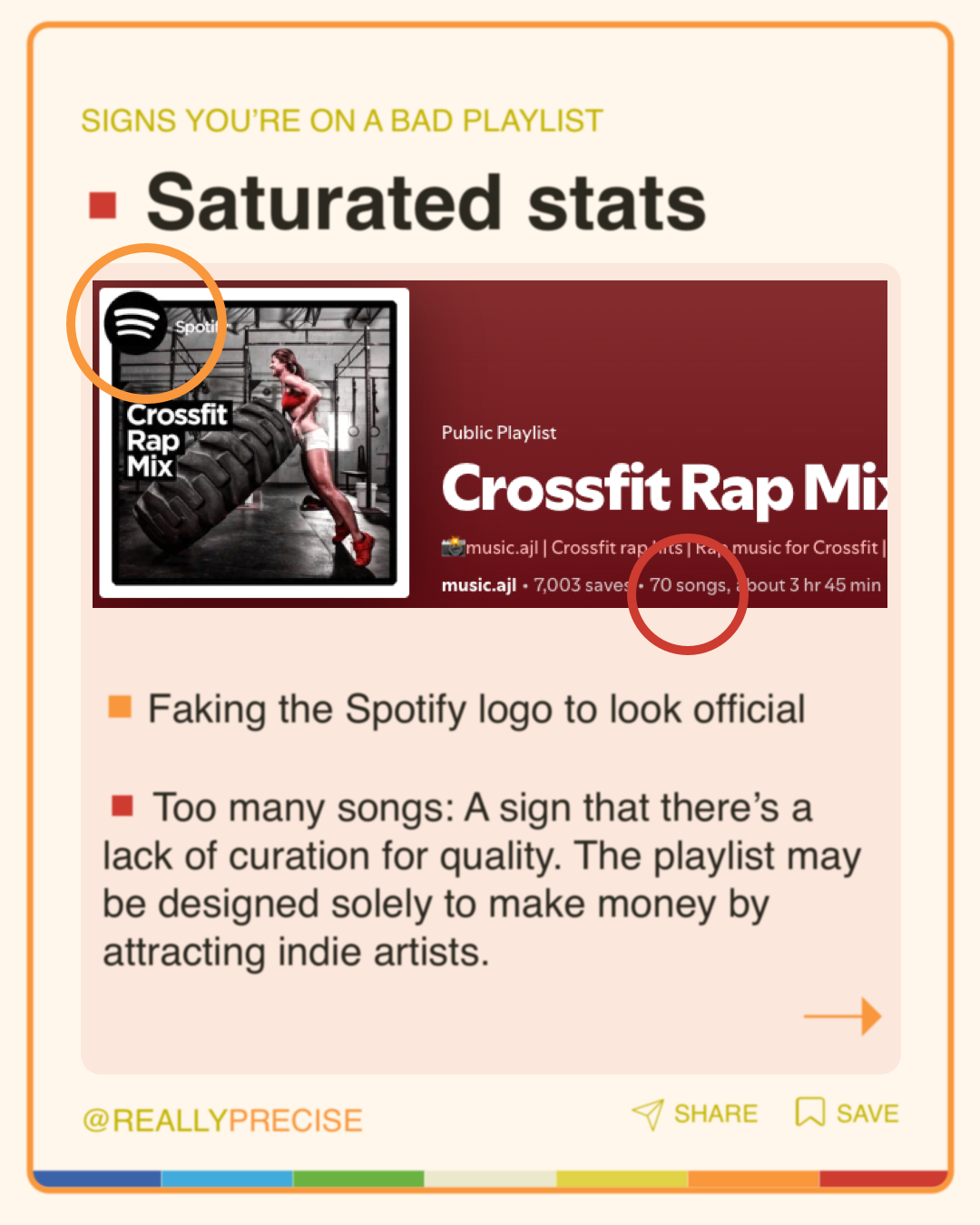
Some curators paste the Spotify logo onto their cover art to imply the playlist is official. Spotify’s own editorial playlists carry Spotify branding natively and are credited to “Spotify” as the owner. A user playlist wearing the logo is deliberately trying to look like something it isn’t — and if a curator is lying about that, assume they’re lying about their numbers too.
3. Your listener geography doesn’t match anything you’ve done
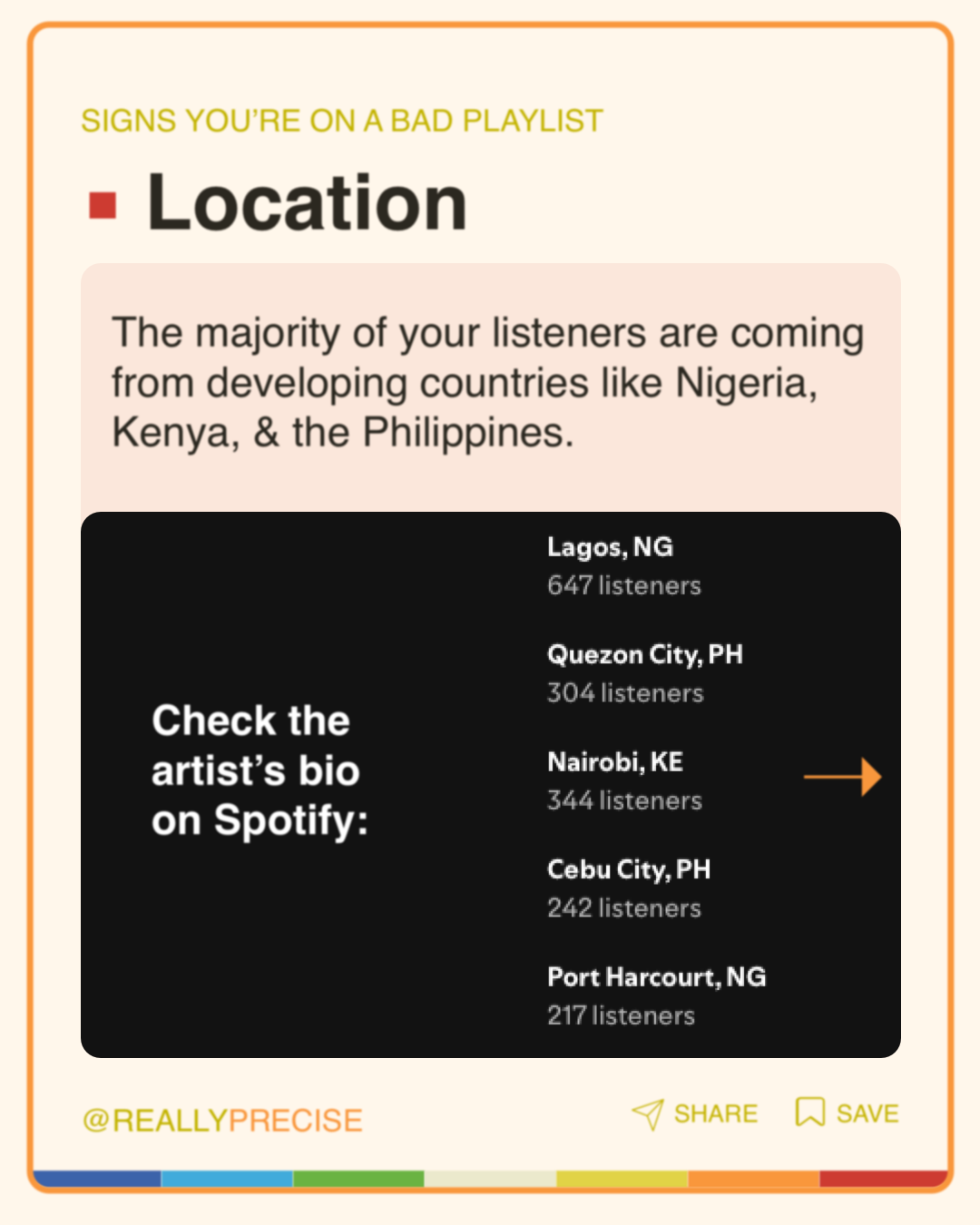
If your streams suddenly concentrate in cities where you have no promotion, no press, and no discernible reason to be blowing up, that mismatch is worth investigating.
To be clear about what the signal actually is: the country isn’t the red flag — the mismatch is. Lagos, Nairobi, Manila, Jakarta and São Paulo are enormous, real music markets with real fans, and plenty of artists build genuine followings there. What should concern you is a sudden spike in a market you’ve never engaged, paired with no corresponding engagement — no follows, no saves, no playlist adds, no repeat listeners. Real audiences leave fingerprints. Click farms leave a flat line.
Check this in Spotify for Artists under Audience, and compare the listener spike against your follower and save trend over the same window.
4. Listeners spike, followers flatline
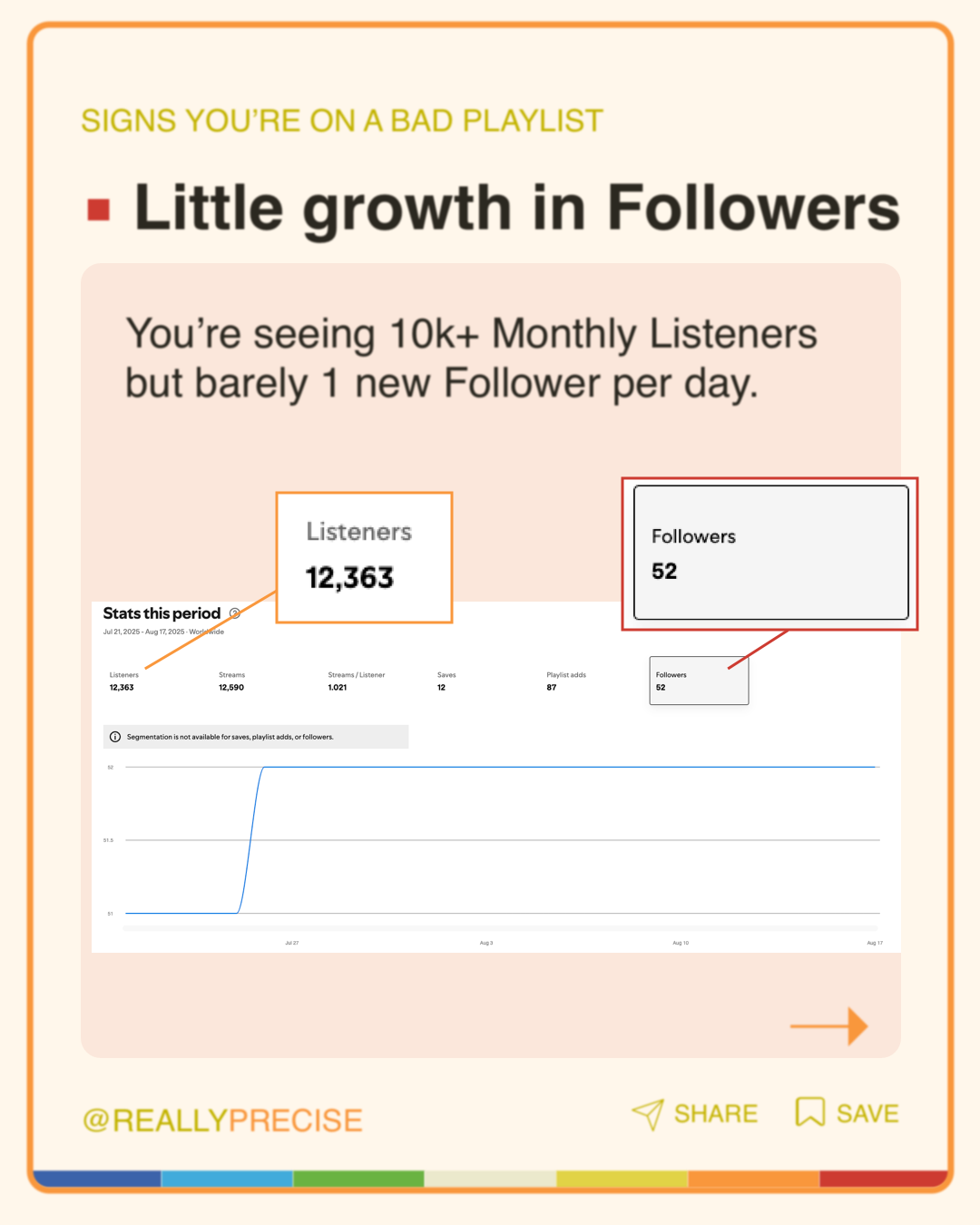
This is the clearest tell of all. If you’re seeing 10,000+ monthly listeners and gaining roughly one follower a day, those listeners aren’t people who like your music.
A useful rough benchmark: with genuinely engaged listening, some meaningful percentage of listeners convert to followers or saves. When you see 12,000 listeners producing 12 saves and 52 followers, you are looking at traffic, not an audience. Pull up the Stats view in Spotify for Artists and compare Listeners against Followers and Saves for the same period — the shape of those two lines tells you everything.
5. Fake compilations and unofficial soundtracks
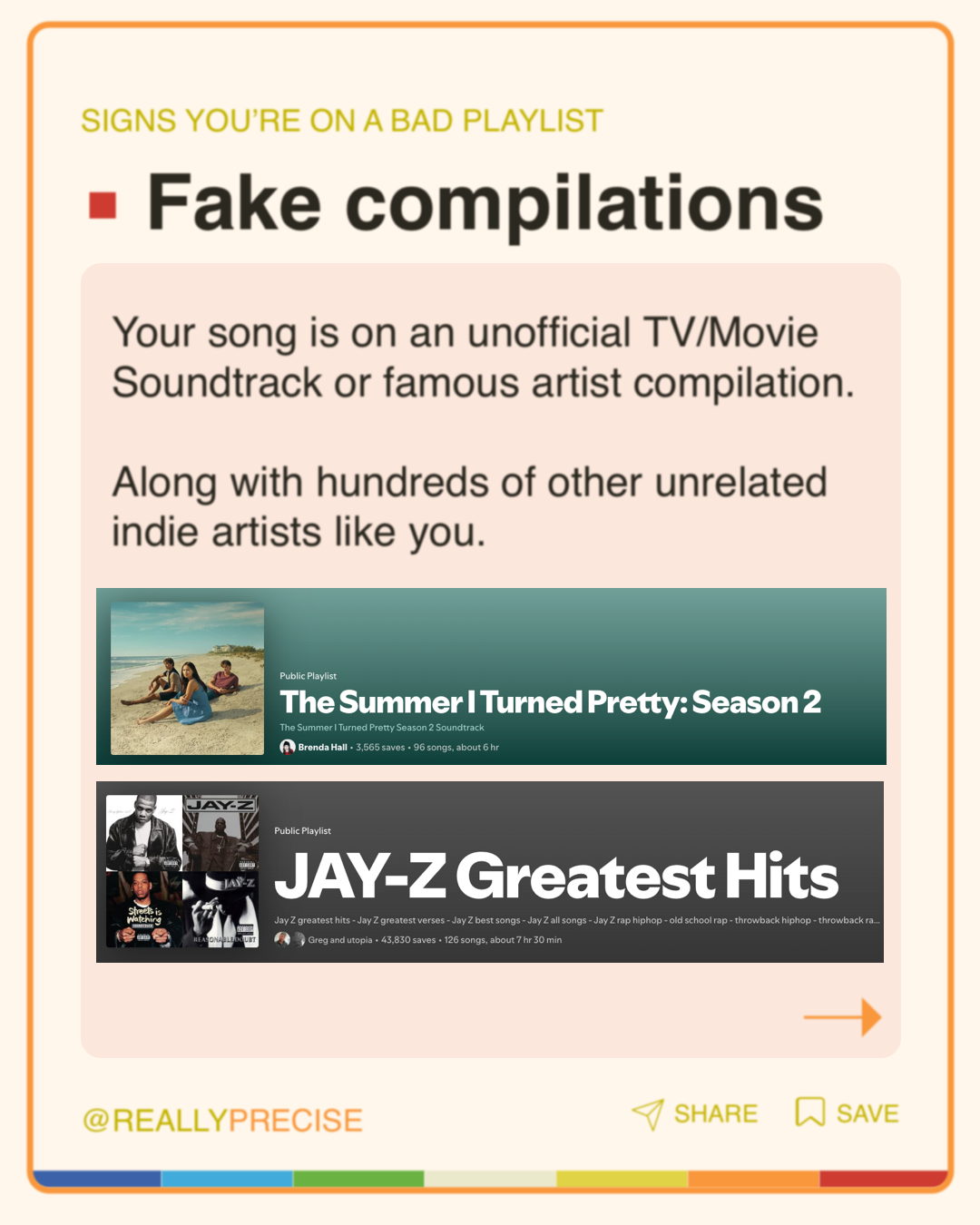
If your song ends up on “The Summer I Turned Pretty: Season 2 Soundtrack” or “JAY-Z Greatest Hits,” alongside a hundred unrelated indie artists, you’re on a bait playlist. These lists rank for high-intent searches, capture listeners looking for something else entirely, and pad the middle with paying artists. The listener came for Jay-Z. They did not come for you, and they will skip.
6. No genre or mood logic
Scroll the tracklist. If a lo-fi bedroom pop song sits between a drill track and a country ballad, there is no curatorial thesis — just inventory. Good playlists have a feeling. You should be able to describe the vibe in one sentence after listening for five minutes.
7. The curator has no identity or footprint
Real curators are findable. They have a name, a website, a social presence, a publication, a radio show, a label, or at minimum a consistent history of playlists in one lane. If the only thing you can learn about a curator is a submission form and a PayPal link, that’s your answer.
8. They guarantee placement, streams, or “algorithmic” results
This one is definitional. Spotify states plainly that paid third-party services that guarantee streams are not legitimate and violate its terms. Any promise of a specific stream count, a guaranteed placement, or “algorithmic push” for money is either fraud or a lie about what they can deliver.
9. Stale playlists that never change
Check when tracks were added. A playlist that hasn’t been updated in eight months isn’t being curated — and if it isn’t being curated, its follower count is a fossil, not an audience.
What are the signs of a good playlist?
Flip every one of the above, and you get a checklist for a placement actually worth having:
- A findable, accountable human behind it — a name, a brand, a history you can verify
- Tight length, roughly 30–60 tracks, updated on a regular cadence
- A clear point of view you can describe in a sentence
- A follower count that is proportionate to the curator’s other channels and reach
- Artists at a similar level to you, not a mix of superstars and total unknowns (superstars on a small user playlist is usually bait)
- Listener geography that makes sense for the curator’s stated audience
- Placements that produce follows and saves, not just plays
- No payment for placement itself, or payment structured explicitly as compensation for listening and reviewing, not for guaranteed inclusion
How do I vet a playlist before saying yes?
Run this before you send anyone money.
- Open the playlist and read the tracklist. How many songs? How long? Does the sequencing make sense, or is it a dumping ground?
- Check the update history. When were the last tracks added? Is there a rhythm to it?
- Click through to three or four artists on the list. Do their profiles look healthy — followers proportionate to listeners, credible city distribution? If the playlist’s other artists all show the same inflated-listener/flat-follower pattern, you’ll get the same result.
- Look up the curator. Website, socials, other playlists. Do they exist outside of Spotify?
- Ask directly how placement is determined. A legitimate operator will tell you they listen and decide. Anyone promising guaranteed inclusion, a stream floor, or a listener number is disqualifying themselves.
- Ask what happens if they don’t like the song. “We’d pass” is the correct answer. “Everyone gets placed” is not.
- Check the follower-to-engagement relationship. A 300,000-follower playlist whose tracks show almost no popularity movement is inflated.
- Search the curator’s name plus “scam” or “review.” Artists talk. Use that.
If a playlist passes all eight, it’s probably real. If it fails three, walk.
What are the actual risks of paying for a bad playlist?
This is where it stops being a wasted marketing budget and starts being a liability.
Financial penalties. Since April 1, 2024, Spotify charges labels and distributors a per-track fee when flagrant artificial streaming is detected on their content. Distributors pass it through — TuneCore, for example, charges the account holder €10 per flagged track, per month, every month the track stays flagged. Multiple tracks, multiple charges.
Withheld royalties and corrected numbers. Artificial streams earn nothing, don’t count toward public stream totals or charts, and are stripped from your metrics — often after you’ve already told people about them.
Removal and delisting. Depending on severity, Spotify may pull songs from playlists, delist tracks entirely, or push your distributor to suspend your account.
Algorithmic damage. This is the cost people underestimate. Spotify’s recommendation systems learn who your music is for by watching who engages with it. Feeding those systems thousands of disengaged or fabricated listens teaches the algorithm that your song is something people skip — and that lesson persists after the placement ends. You can spend months undoing it.
The 1,000-stream threshold trap. Tracks need at least 1,000 streams in the previous 12 months to earn royalties at all. Artists sometimes buy streams to cross that line. Since artificial streams don’t count toward the threshold and can trigger penalties, this is one of the fastest ways to turn a small problem into an expensive one.
Is paying for playlist promotion ever legitimate?
Sometimes — but the distinction matters enormously.
Paying for guaranteed placement is never legitimate. It violates Spotify’s terms, and the whole business model depends on the curator not caring whether your song is good.
Paying for consideration can be legitimate. Platforms like SubmitHub and Groover charge artists a small fee that compensates curators for the time spent listening and writing feedback. You’re buying a guaranteed listen, not a guaranteed placement, and rejection is a normal, expected outcome. The economics only work honestly if most submissions get declined — so if a review service places nearly everything it receives, treat it the same as any other pay-for-play scheme.
Spotify’s own tools are legitimate by definition, though not free of tradeoffs. Discovery Mode lets you flag tracks for algorithmic prioritization in exchange for a reduced royalty rate on the resulting streams. It’s not fraud, but it has drawn sustained criticism — including from US legislators and in litigation — as a modern form of payola that pressures artists into accepting less money to be heard. Worth understanding before you opt in.
Traditional advertising is legitimate. Meta, TikTok, and Spotify’s own ad products put your music in front of real people who chose to click. That’s a fundamentally different transaction from buying a number.
What should you do instead?
The uncomfortable truth is that the alternative to buying fake playlist placements is slower and less flattering to your dashboard.
- Pitch editorial through Spotify for Artists for every release, at least 7 days out, ideally 3–4 weeks. It’s free, it’s the only legitimate route, and even an unsuccessful pitch feeds Spotify metadata about your song.
- Build your own playlists and cross-promote with artists in your scene. Curator relationships often start as peer relationships.
- Research curators who actually cover your genre and pitch them like a human — with context, a reason you belong on their list, and no mass-BCC.
- Optimize for saves, not streams. A save is a listener telling the algorithm they want this again. Ask for saves and follows explicitly; most listeners don’t think to.
- Convert listeners into something you own — mailing list, Discord, ticket sales. Platform metrics are rented. Fan relationships are not.
- Treat 1,000 real fans as the goal, not 100,000 fake listeners. One is a career. The other is a screenshot.
Less is more. One placement on a playlist people genuinely love will do more for you than a hundred placements on lists nobody listens to — and it won’t cost you a penalty fee, a delisting, or a poisoned algorithm.
Frequently asked questions
How can I tell if a Spotify playlist is fake?
Look for four things together: excessive length (3+ hours or 70+ tracks), no coherent genre or mood, an anonymous curator with no presence outside Spotify, and other artists on the list showing high monthly listeners with almost no followers or saves. Any one of those alone is a caution; all four together is a fake.
Does being on a bad playlist hurt my Spotify algorithm?
Yes. Spotify’s recommendation systems learn from engagement signals like saves, completion, and skip rate. Placements that generate disengaged or artificial listening teach the algorithm that listeners don’t want your music, which can suppress your reach on Discover Weekly and Release Radar well after the placement ends.
Can Spotify penalize me for buying playlist placements?
Yes. Spotify may remove affected tracks from playlists, delist them entirely, withhold royalties, and correct your public stream counts. Since April 2024 it also charges labels and distributors a per-track fee for flagrant artificial streaming — distributors typically pass this on to the artist, often around €10 per flagged track per month.
How many songs should a good playlist have?
Roughly 30–60 tracks, or about 90 minutes to two hours. That’s long enough to be worth following and short enough that a real listener can get through it, which means your placement is actually heard rather than buried at position 214.
Are monthly listeners or followers more important?
Followers, by a wide margin. Monthly listeners count anyone who pressed play once, including bots. Followers chose to keep you, and every new release goes straight to their Release Radar. Saves matter for the same reason — both signal intent, while monthly listeners signal only exposure.
Should I pay for playlist placement at all?
Not for guaranteed placement — that violates Spotify’s terms and doesn’t produce real fans. Paying a small fee for a curator’s time and honest review, through a platform where rejection is a normal outcome, is a different thing and can be worthwhile. The test is simple: are you buying a listen, or buying a result?
How long does it take to see real results from a good playlist placement?
Expect a stream bump within days, but judge the placement on what happens over the following 4–8 weeks — whether followers and saves grew, whether algorithmic playlists picked the song up afterward, and whether your next release performed better from the start. A good placement compounds. A bad one spikes and vanishes.
.jpg)
REALLY PRECISE
What we do
We're one of Canada's leading music marketing agencies. We get your music in front of the right audience. With really precise Facebook/Instagram Ads at indie-friendly prices.