Music Royalties Explained (2026 Canadian Edition): Where to Register
A straightforward guide on how to claim the rights and royalties for your music in Canada. Where to register and what the different organizations like SOCAN, CMRRA, Artisti, and Panorama do.
If you write, perform, and release your own music in Canada, there are four organizations holding money for you right now. Most artists are aware of SOCAN. But there are actually 4 main streams of income you may be missing out on. None of them will contact you. You have to go and claim it.
TL;DR — register for these four
If you don't want to be overwhelmed with options and information, just register for these four organizations. Do them in order. All four are free to join but it can take months for you to get paid because of payout schedules.
- SOCAN (Performing Rights) — pays you as the songwriter, when your song is streamed, broadcast, or performed in public. Skip their Reproduction Rights for now (see next point).
- CMRRA — pays you as the publisher, for mechanical royalties every time your song is reproduced. Yes, a stream counts twice: once for SOCAN, once here.
- ARTISTI — pays you as the performer, for your half of neighbouring rights when the recording gets airplay.
- Panorama — pays you as the master owner, for the other half. Formerly SOPROQ. If you paid for your recording, this is you.
That’s it. If you do nothing else after reading this, do those four.
Now we'll dive into the details.
Why are there four different organizations?
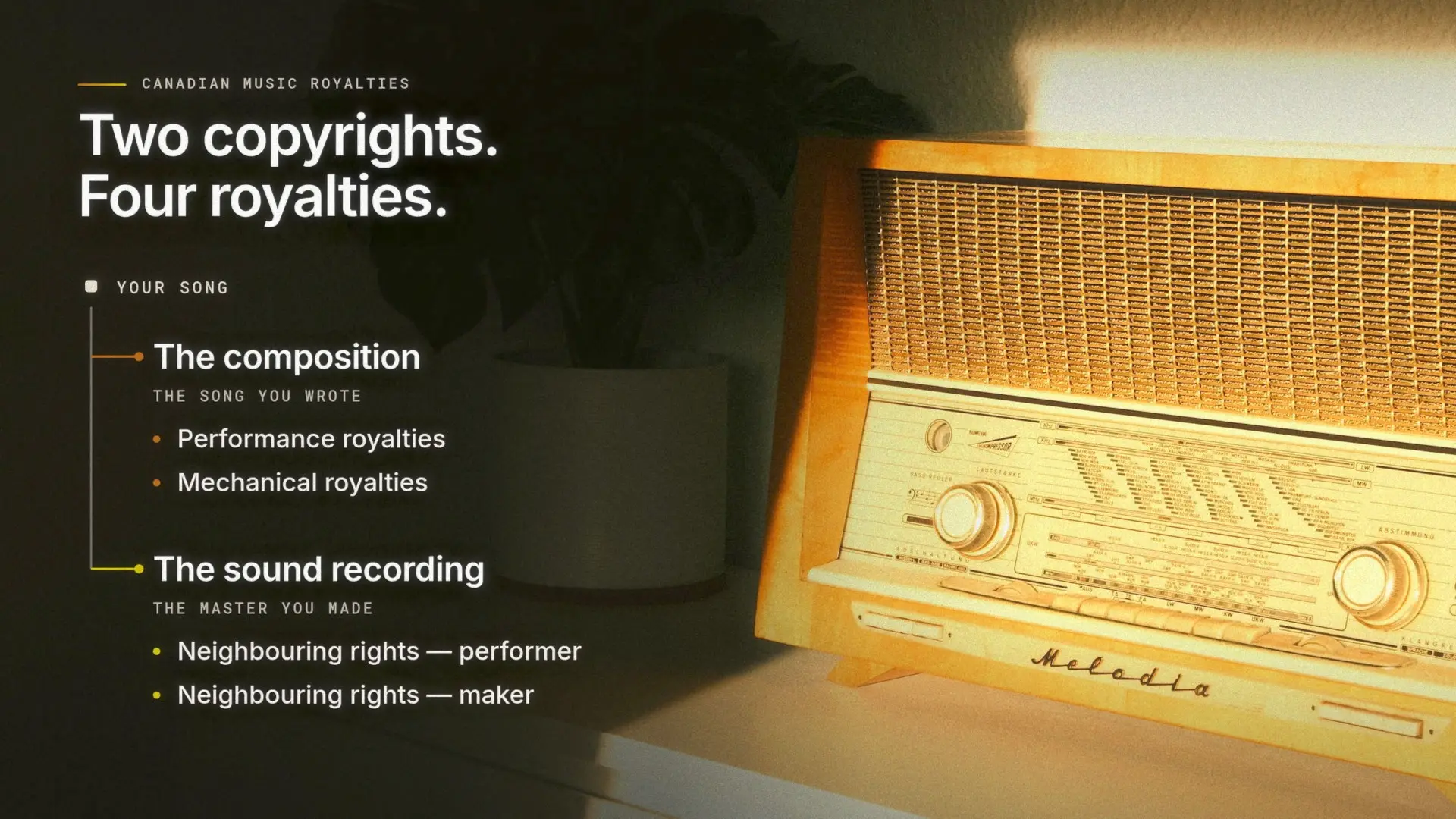
One song is legally two separate pieces of property.
The composition is the song itself — the melody, chords, and lyrics. It exists independently of any recording. It belongs to the songwriter and the publisher.
The sound recording — the “master” — is one specific captured performance of that composition. It belongs to the performers who played on it and the maker who paid for it.
Record a cover of someone else’s song and you own a master but no composition. Write a song that another artist records and you own a composition but no master. Write, perform, and fund your own release and you own both, which means you occupy four roles at once: songwriter, publisher, performer, and maker.
Those four roles are the four registrations. The rest of this article is just which organization serves which role.
1. The composition side: money for the song you wrote
Two royalties come off the composition, and they’re triggered by different things. Performance royalties are generated when your song is performed — heard by the public. Mechanical royalties are generated when it’s reproduced — copied onto something, including a stream.
The confusing part is that a single stream does both at once. It reproduces the work and performs it publicly, so it pays out through two organizations. Most self-releasing artists register for the first and never learn about the second.
Performance royalties — SOCAN
SOCAN collects performance royalties for the composition. Your song generates them when it’s streamed, played on radio or television, performed live in a licensed venue, or played in a store, restaurant, or gym. SOCAN is Canada’s performing rights organization and covers you internationally through reciprocal agreements with foreign societies.
There’s no fee to join. Two things people get wrong:
- Register as a publisher as well as a writer. Performance royalties pay out in two halves — a writer’s share and a publisher’s share. With no publisher entity attached to your works, that second half has nowhere to go. If you have no publishing deal, the publisher is you.
- Reproduction rights are a separate opt-in. SOCAN offers them, but membership doesn’t include them automatically.
Alternatives: none, realistically. SOCAN is Canada’s only performing rights organization, and you can belong to just one PRO worldwide.
Mechanical royalties — CMRRA
CMRRA collects mechanical royalties, owed every time your composition is reproduced. That covers vinyl, CDs, downloads, and every individual stream.
This is the single most commonly missed stream for self-published Canadian songwriters, because “a stream is also a reproduction” isn’t intuitive. It genuinely is a second royalty from the same play, and if you’ve never registered with CMRRA or opted into SOCAN’s reproduction rights, nobody has been collecting it.
CMRRA charges nothing upfront and takes a cut of what it collects. Since 2021 it has also collected your mechanicals in the United States and across Europe, the UK, and the MENA region, so one registration covers considerably more than Canada.
One thing to watch: on July 29, 2026, SOCAN announced an agreement to acquire CMRRA. If it closes as announced, Canadian performing and mechanical rights end up under one roof for the first time. It doesn’t change what you should do today — but expect the two to converge.
Alternatives:
SOCAN Reproduction Rights does the same job, so if you’d rather keep everything under one login, opt into it instead. However, the new SOCAN portal is a big mess and customer support is extremely slow and overwhelmed. Which is why we recommend CMRRA at this time.
A publishing administrator — Songtrust, Sentric and similar — is the third route, and a publishing deal makes it your publisher’s problem entirely. Whichever you choose, only one party can claim a given work. Registering the same songs with two of them creates a conflict that holds the money.
2. The recording side: money for the master you made
When a recording is broadcast or played in public in Canada, the people who made it are owed a payment entirely separate from anything the songwriter receives. These are neighbouring rights, and the Copyright Act splits the money 50/50 between the performers and the maker.
That 50/50 split is why there are two organizations here rather than one. If you sang on the record and paid for the session, both halves are yours — but you have to claim them in two different places.
Neighbouring rights, performer’s half — ARTISTI
ARTISTI collects the performer’s share of neighbouring rights. It’s open to any performer on an eligible recording: lead or backing, featured or session.
ARTISTI is run by the Union des artistes, but you do not need to be in Quebec or in a union to join. Joining is free, with management fees deducted from what’s collected, and it claims for you across dozens of territories rather than Canada alone.
(If you ever registered with MROC, this is where your account went. MROC stopped distributing to individual performers on December 31, 2024 and wound down. Performer mandates transferred to ARTISTI on January 1, 2025 unless the performer had chosen another collective.)
Alternatives: ACTRA RACS does the same job, is equally open to non-union artists, and divides its pool between featured and non-featured performers. You can also register directly with Re:Sound, though going through a collective is what gets you claimed internationally rather than in Canada alone. All three are fine choices. Pick one — two collectives holding a mandate over the same performances delays your money instead of doubling it.
Neighbouring rights, maker’s half — Panorama
Panorama collects the maker’s share — the money owed to whoever owns the sound recording. If you funded your own recording, you are the maker, and nobody else is claiming this on your behalf.
SOPROQ was renamed Panorama on September 17, 2025. Same organization, founded in 1991, but no longer a Quebec-only story: it now operates nationally through alliances with CIMA and CONNECT Music Licensing. The old domain redirects, which is why you’ll still find both names in older guides and forum threads.
Panorama members can also manage their US performer royalties from inside the same account, which matters below.
Alternatives: register directly with Re:Sound as a maker. And if you’re signed, check before you do anything — the major labels are Re:Sound members in their own right, so your label may already be claiming the maker share on recordings it owns. The question to answer first is who actually owns the master, not who to register with.
The licensing body behind both — Re:Sound
You don’t register with Re:Sound directly, but you should know what it is. Re:Sound is the organization that actually licenses recorded music to Canadian radio, television, webcasters, and businesses, then distributes the money. ARTISTI and Panorama are its member collectives — joining them is what connects you to it.
This is where the real deadline lives. Re:Sound closes out distribution years permanently. Performers have until September 1 of the sixth year following the year being distributed. Makers only get until the fourth year. Older catalogue years have already closed for good.
Registering today usually pulls in a chunk of back royalties. Registering in five years pulls in less, and some of it will be gone.
US digital performance royalties — SoundExchange
You probably don’t need a fifth registration for this. Re:Sound holds a bilateral agreement with SoundExchange that covers Canadian rights holders signed up directly with Re:Sound or through any of its member collectives. In practice, ARTISTI claims your US performer share and Panorama your US maker share, and you’ve already done the work by joining them.
Alternatives: register with SoundExchange directly. You keep the commission your collective would have taken, but you file your own W-8BEN — without it, tax is withheld off the top — and you chase your own unmatched recordings yourself. Both routes are legitimate; the deciding factor is whether you’d rather pay a commission or do the admin. What breaks is doing both, since two parties claiming the same recording is a conflict, and conflicts pay nothing while they sit open.
What does this look like for one actual song?
Say you write a track called Moneymaker, record it in a studio you paid for yourself, and release it independently. You’re the songwriter, the publisher, the performer, and the maker all at once, so every dollar it generates belongs to you — through four different doors.
Someone streams it on Spotify. Two royalties come off the composition: a performance royalty through SOCAN and a mechanical royalty through CMRRA, from the same play. The recording side is paid by the DSP to your distributor, which is the money you already see in your dashboard. Nothing goes through Re:Sound, because an on-demand stream isn’t a broadcast.
CBC Radio plays it. Now all four organizations pay at once. SOCAN collects your performance royalty and CMRRA the broadcast reproduction on the composition side. On the recording side, the broadcast triggers neighbouring rights: ARTISTI claims your performer half and Panorama your maker half, both flowing through Re:Sound. One radio spin, four cheques.
A Montreal coffee shop plays it over the speakers. Same shape as radio, minus the reproduction — SOCAN for the composition, ARTISTI and Panorama for the recording.
A US satellite radio channel adds it. That’s SoundExchange money, claimed for you by ARTISTI and Panorama under Re:Sound’s agreement — or by you directly, if you registered with SoundExchange yourself.
Now a band in Vancouver records a cover version. This is where the split gets obvious. You wrote the composition, so SOCAN and CMRRA still pay you every time their version is streamed or played. But you didn’t perform on their recording and you don’t own it, so you get nothing from ARTISTI or Panorama for it — those go to the band and whoever paid for their session. Their master, your song.
What do most Canadian artists get wrong?
- Assuming the distributor handles it. DistroKid, TuneCore and CD Baby collect your streaming master royalties — one stream out of many. They don’t collect performance, mechanical, or neighbouring rights unless you’ve bought a separate publishing admin add-on.
- Joining but never registering the works. An account with no catalogue in it pays nothing. Every organization above needs your ISRCs, ISWCs, splits, and contributor roles — and needs them again for every new release. This is time-consuming process, but it is critical.
- Registering as a writer but not a publisher. That’s half your performance royalties sitting unclaimed.
- Splits that don’t match. If your co-writer files 60% and you file 50%, the claim conflicts and the money holds. Do the split sheet before release, and make sure both of you register identical numbers.
- Claiming the same right twice. ARTISTI and ACTRA RACS. SOCAN reproduction rights and CMRRA on the same works. ARTISTI and a direct SoundExchange registration. Every one of these freezes money rather than doubling it.
- Waiting. See the Re:Sound deadlines above.
Frequently asked questions
Do I really need all four, or can I just pick one?
All four, if you write, perform, and own your recordings — each administers a legally distinct right that none of the others can collect. If you only write and don’t perform on the recordings, you need the composition side: SOCAN and CMRRA. If you only perform on other people’s records, you need ARTISTI.
Is it free to register with SOCAN, CMRRA, ARTISTI and Panorama?
Yes, all four. There’s no membership fee anywhere on this list. Each takes a commission on royalties it actually collects for you instead, so the cost only ever comes out of money you wouldn’t otherwise have received.
Does my distributor already collect these royalties?
No. Your distributor collects master recording royalties from streaming and downloads. Performance, mechanical, and neighbouring rights all require separate registration. Check exactly what your plan includes — “royalty collection” in marketing copy usually just means the part they already do.
What happened to SOPROQ and MROC?
SOPROQ was renamed Panorama on September 17, 2025 — the same organization, now operating nationally. MROC stopped distributing to individual performers on December 31, 2024 and wound down, with performer mandates transferring to ARTISTI on January 1, 2025 unless the performer had chosen another collective.
Do I need to register with SoundExchange separately?
Not necessarily. Re:Sound has a bilateral agreement with SoundExchange covering Canadian rights holders registered through its member collectives, so ARTISTI can claim your performer share and Panorama your maker share. Registering directly avoids their commission but means filing your own W-8BEN and chasing your own unmatched royalties. Pick one route — claiming through both stops payment entirely.
Do I need to be in Quebec to join ARTISTI or Panorama?
No. Both have Quebec roots and both operate across Canada. ARTISTI is open to any performer on an eligible recording, and Panorama is open to all makers and copyright holders of sound recordings and music videos.
Can I still collect royalties from years ago?
Usually yes, and late registration often produces a surprisingly large first payment. But Re:Sound closes distribution years permanently — six years for performers, four for makers — after which the money is redistributed to other rights holders. The longer you wait, the more of your back catalogue stops being claimable.
.jpg)
REALLY PRECISE
What we do
We're one of Canada's leading music marketing agencies. We get your music in front of the right audience. With really precise Facebook/Instagram Ads at indie-friendly prices.